
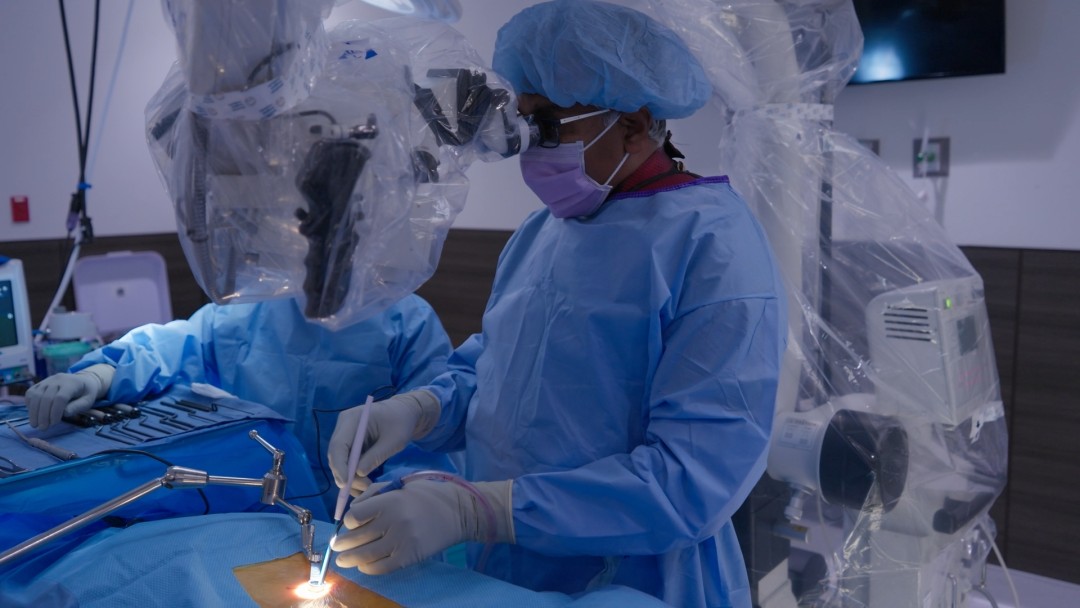
In the era of ChatGPT, self-driving cars, and smart homes, we have become accustomed to the idea that "newer is better." We constantly upgrade our devices, download the latest firmware, and expect our technology to be intuitive, fast, and glitch-free. Yet, when it comes to the most complex machine we own—the human spine—we often rely on an "operating system" that hasn't changed much in decades.
Traditional spine care can feel like using a dial-up modem in a 5G world: slow, disconnected, and frustrating. But in Miamisburg, Ohio, a new standard is emerging. It is a standard driven not just by robotic arms or laser guidance (though those are present), but by a unique configuration of human expertise. If we view a medical practice as a high-performance service product, then the "specs" matter immensely. Here is why the specific architectural makeup of Dr. Kamal Woods represents a massive leap forward in the technology of healing.
The Dual-Core Processor: Bridging the Ortho-Neuro Divide
In computing, a dual-core processor allows a system to handle multiple complex threads simultaneously without crashing. In the world of spinal health, the equivalent is the rare dual-fellowship training. Historically, you had to choose between a neurosurgeon (the "electrician" of the nervous system) and an orthopedic surgeon (the "structural engineer" of the bones).
Dr. Woods didn't choose; he integrated. After a grueling neurosurgery residency at Loma Linda University—a Level I Trauma Center known for high-acuity cases—he completed a Combined Orthopedic & Neurosurgery Spine Fellowship at the world-renowned Cedars-Sinai Medical Center in Los Angeles. This gives him a "hybrid" processing power. He creates surgical plans that protect delicate nerve roots with microscopic precision while simultaneously ensuring the architectural stability of the spinal column. This isn't just a resume bullet point; it is a fundamental upgrade to patient safety, reducing the "bugs" and "system failures" often seen in single-specialty approaches.
The User Interface (UI) Upgrade: The MBA Difference
We have all experienced "bad UI" in healthcare: the confusing insurance forms, the endless hold times, the feeling of being a number in a spreadsheet. It is a system designed for the provider, not the user. Dr. Woods recognized that clinical excellence is useless if the delivery system is broken. To fix the "user experience" (UX), he went to business school.
Armed with an MBA from the Johns Hopkins Carey Business School, Dr. Kamal Woods has re-engineered the patient journey. He applies high-level operations management strategies to his practice, removing the friction that plagues traditional medicine. This means streamlined scheduling, transparent communication, and a "concierge" feel that respects your time as a valuable asset. By treating the practice as a service product, he ensures that the administrative side of your care is as precise and professional as the surgical side.
The "MotionFirst™" Algorithm: Updating the Code
For years, the default code for back pain was "fusion.exe"—welding bones together to stop the pain. While effective for stability, fusion comes with a cost: loss of movement. It’s like freezing a hinge to stop it from squeaking; the door stops making noise, but it also stops opening.
Dr. Woods operates on a more advanced algorithm: MotionFirst™. This philosophy prioritizes technologies that preserve your natural biomechanics. Through the use of artificial disc replacement and other motion-sparing techniques, he aims to keep the "system" flexible. This approach is akin to a software patch that fixes the glitch without limiting the functionality of the hardware. Whether you want to swing a golf club or simply tie your shoes, this forward-thinking protocol is designed to keep you active, not just stable.
Quality Assurance: The Board Certification Standard
In software development, Quality Assurance (QA) is the critical phase where a product is tested for reliability before release. In neurosurgery, the American Board of Neurological Surgery (ABNS) serves as this ultimate check. It is a rigorous, ongoing audit of a surgeon’s knowledge, judgment, and outcomes.
As a Fellow of the American Association of Neurological Surgeons (FAANS), the expertise of Dr. Kamal Woods has been validated against the highest benchmarks in the field. This certification is your warranty. It signals that the care you receive is not experimental or reckless, but grounded in evidence-based science and peer-reviewed safety standards. It provides the peace of mind that comes from knowing your surgeon has "passed the audit" of the most demanding critics in medicine.
The Final Verdict: A System Built for You
When you combine these elements—the hybrid "hardware" of dual training, the optimized "UI" of an MBA-led practice, and the advanced "software" of MotionFirst™—you get a service product that is in a category of its own.
Dr. Woods has essentially productized excellence. He has taken the most complex, high-stakes elements of surgery and packaged them into a seamless, patient-centered experience. If you are navigating the complex world of spinal health, don't settle for legacy systems. Choose the upgrade. Choose a provider who understands that the future of medicine isn't just about better machines, but about a better, more human way of delivering care.
Media Contact
Company Name: vertae
Email: Send Email
Phone: 844-255-2225
Address:4501 Lyons Road
City: Miamisburg
State: OH 45342
Country: United States
Website: https://vertrae.com/